
Making History

Monday, July 13, 2026
Northeastern Professor and Associate Chair of the Department of History Joshua Salzmann, Ph.D., doesn’t just teach history, he helps make it.
In September 2022, a complaint was filed in the U.S. District Court for the Northern District of Illinois. The case, Schoenthal v. Raoul, questioned whether or not the State of Illinois could ban ordinary citizens from carrying firearms on public transit or, if doing so violates the Second and 14th Amendments of the U.S. Constitution. Dr. Salzmann, who is a historian of U.S. cities with a primary focus on Chicago, was called by the State as an expert witness. Illinois Attorney General Kwame Raoul and his team made the argument that guns should not be allowed on public transit. The case went as high as the U.S. Court of Appeals for the Seventh Circuit, which sits one level below the U.S. Supreme Court. Earlier this year, in part because of evidence provided by Dr. Salzmann, the Court ruled that firearms were not allowed on transit in the past and shouldn’t be currently.
“As an expert witness the main thing I did was conduct research and write very long reports for the judge and then, sometimes, weigh counterevidence cited by the gun rights groups’ lawyers,” said Dr. Salzmann, who’s been teaching at Northeastern since 2012.
In 2017, Dr. Salzmann published his first book, “Liquid Capital: Making the Chicago Waterfront” (University of Pennsylvania Press). The book discusses how the city managed its waterways for transportation, drinking and sanitation. In 2018, the book was awarded a “Superior Scholarly Achievement Prize” from the Illinois State Historical Society. In 2019, it earned an honorable mention in the Jon Gjerde Prize competition, which recognizes the best book on Midwest History.
“I did not set out to research gun rules on transportation,” Dr. Salzmann said. “One of my colleagues who studies gun control recommended me as someone to work with attorney general’s offices on the issue because ‘Liquid Capital’ dealt with transportation and another focus of my research is guns.”
This is not the first court case in which Dr. Salzmann has been called as an expert witness. He was also called in the case of May v. Bonta, Carralero v. Bonta — a case in California that challenged the legality of the state’s Senate Bill 2, which restricted firearms in "sensitive places” such as hospitals, places of worship, libraries and public transit. The ban has been upheld, but it may still be appealed.
“The cases that I have worked on were about carrying weapons on public transit,” Dr. Salzmann said. “Once asked to help, I conducted research for the Attorney General’s offices of Illinois, California and Washington D.C. to determine what the rules were in the past for carrying guns on ferries, trains, stage coaches, buses, etc. I found a lot of evidence of regulation of guns. Mostly, there were rules that said you could take your weapons on those modes of travel but that they had to be dismantled and stored in cases. There wasn’t a ‘wild west’ where people sat on trains with guns on their hips.”
Dr. Salzmann has published essays in the Chicago Tribune, Crain’s Chicago Business and Smithsonian Magazine. Additionally, his peer-reviewed academic journal articles have appeared in Enterprise and Society, LABOR, Journal of Illinois History and City of Lake and Prairie. He is currently working on his second book, tentatively titled “City of Guns: Chicago, Race, and the Transformation of American Firearms Law,” which traces the history of gun control laws in Chicago from the 1960s to the 2010s.
Professor and Chair of the Department of History Mateo Farzaneh, Ph.D., is proud that Dr. Salzmann’s research is able to contribute to public scholarship and show students how research can impact our society.
"Dr. Salzmann’s work perfectly illustrates how rigorous historical scholarship directly informs the pressing legal and constitutional debates of our modern world," said Dr. Farzaneh, who is also Chair of the Department of Political Science. “It is important to see that research doesn’t live in a vacuum. It can and does have a real impact.”
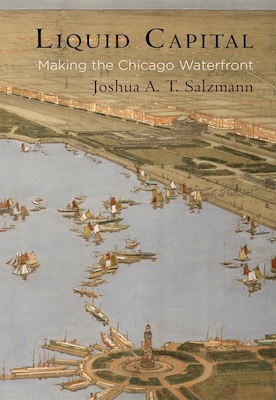
Book cover of "Liquid Capital: Making the Chicago Waterfront."
Top photo: Professor and Associate Chair of the Department of History Joshua Salzmann, Ph.D.